October 15, 2026
Peridot: Born in Fire, Fallen From the Sky


Peridot — for vibrant warmth
Chakra Heart, Solar Plexus · Hardness Mohs 6.5 - 7 · Best for warmth and renewal
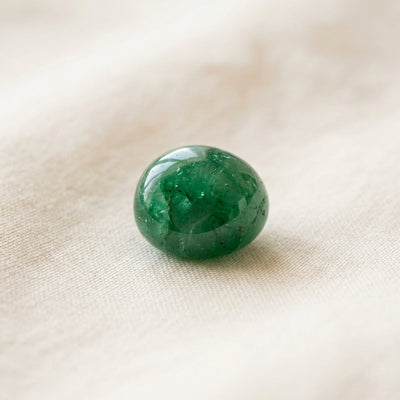
Most stones are made in the dark, pressed slowly into being somewhere in the earth’s crust. Peridot is not most stones. It forms far deeper, in the mantle — the churning rock that only ever reaches us when a volcano tears it loose and throws it toward the light. Walk the black-sand beaches of Hawaii and you can find it scattered there like spilled sequins, tiny grains of green that came up through fire. It is, quite literally, the stone that survives the eruption.
Born in fire, fallen from the sky
And then there is the other half of its story, which sounds like something a child would invent. A rare class of meteorite called a pallasite carries gem-quality peridot inside it — crystals of green suspended in iron and nickel, older than the earth, formed at the heart of some long-shattered world and then falling, after billions of years, into ours. The green you hold in a ring may have come up through a volcano, or it may have come down out of the night sky. Either way it was forged somewhere extreme and arrived somewhere gentle. That is the whole meaning of the stone in a single sentence.
The ancient world loved it for a plainer reason: it seemed to glow. The Egyptians mined it on a scorched island in the Red Sea they called Topazios — known now as Zabargad — and the old accounts say the miners worked at night, because the green was easier to spot in the dark than in the glare of the desert sun. They named it the gem of the sun and gathered it out of the shadows. It is very likely that some of Cleopatra’s famous emeralds were never emeralds at all, but this.
What peridot is for
Peridot is a stone of warmth and renewal — the light that comes after the hard season, not instead of it. Where emerald is the deep, settled green of a love that has already decided to stay, peridot is the brighter, sunnier green of first growth: the shoot that pushes up once the frost has finally broken. It sits across both the heart and the solar plexus, and that pairing is the whole point. It warms the heart and steadies the gut at once — tenderness and nerve together, which is precisely the mix you need to begin something again.
It has always been tied to abundance, and to a particular, friendly kind of it. Not the cold accumulation of more, but the open-handed warmth of enough: a good harvest, a full table, a season that turns at last in your favour. If you have come through a long, depleting stretch and are only now feeling the heat return to your hands, this is the stone that matches that feeling.
One honest note on care.
Peridot is softer than it looks — 6.5 to 7 on the Mohs scale, about the hardness of a steel blade — and it has no love for sudden heat or harsh chemicals. Keep it clear of ultrasonic cleaners, hot water and acid, and give it lukewarm water, a drop of mild soap and a soft cloth instead. Store it apart from harder stones so nothing scratches that bright face. Treated kindly, the green stays as fresh as the day it left the fire.
How to wear it
Peridot wants light. It is one of the very few gems that comes in only one colour — always green, lit from within by the iron that is part of its own structure rather than any borrowed tint — so it reads best where the sun can reach it: a pendant that catches a window, a ring you turn toward the light without thinking. Its lime-bright green flatters warm skin especially, and it lifts a quiet outfit the way a sprig of something fresh lifts a plate.
On a grid it belongs among the warm, growing stones. Set it beside citrine and sunstone for a corner that is all heat and optimism, or beside green aventurine and rose quartz for renewal with a softer, kinder edge. A little clear quartz among them makes the whole arrangement feel brighter still.
Who reaches for peridot
Peridot tends to find the person on the far side of something difficult — the end of a draining year, a loss, a stretch where everything felt like winter. Not the one still in the thick of it, but the one just beginning to feel the thaw, who wants a little help trusting that the warmth is real and here to stay. If you are ready to begin again, and you would rather do it in colour than in caution, this is your stone. It came through fire too, and it kept every bit of its green.
New to all of this? Begin in the crystal library, or let the quiz point you to the stone that meets you exactly where you are right now.
Next in Gemstone 101: larimar — a stone the colour of shallow tropical water, born of the same volcanic fire but found in only one place on all the earth.
— Sofia