The July Birthstone: A Complete Guide to Ruby, Its Meaning, and How to Wear It


There is a reason Ruby has been called the king of gemstones for two thousand years — and it is not just the color. This is a stone people once believed could hold a fire that never went out, one that reset itself in your palm.
If you were born in July, this is your birthstone. If you were born in another month and are here anyway, welcome — Ruby wasn't only ever meant for one kind of person. This is our thorough guide: what Ruby means, why it became July's stone, how to wear it, how to care for it, and which pieces from Sofia's studio might feel most yours.
What is the July birthstone?
The July birthstone is Ruby. This has been true in most modern birthstone lists since the American Gem Society formalized the modern list in 1912, and it aligns with much older astrological and lapidary traditions dating back to at least the 15th century.
Some traditional lists also include Onyx as an alternate July stone, or Turquoise in a few Eastern traditions. But if a jeweler or a friend asks about your July birthstone, the answer they mean is Ruby.
The story of Ruby
Ruby is a variety of the mineral corundum — the same mineral that makes Sapphire. The two are chemically identical: aluminum oxide. What separates them is trace chromium. A dash of chromium turns corundum into the red we call Ruby; iron or titanium gives us the blue of Sapphire.
For most of human history the finest Rubies came from Mogok in what is now Myanmar. Kings from Delhi to Persia commissioned pieces from those mines. In 15th-century Europe, warriors wore Ruby into battle, believing it would give them the strength of a lion.
The Sanskrit word for Ruby, ratnaraj, translates to "king of precious stones." That title stuck for a long time — Ruby remained one of the four "cardinal gems" (with Sapphire, Emerald, and Diamond) until the 19th century.
At Sofia's studio, we source Ruby beads that are natural corundum — untreated where possible, always ethically sourced. The color ranges from deep pomegranate to bright cherry.
What Ruby means
Ruby is traditionally the stone of courage, passion, and vitality. In practical terms, this is the crystal you reach for when you need to walk into a room and take up space in it.
- Chakra: Root and Heart. Root for grounding, Heart for love and courage.
- Element: Fire.
- Zodiac: Leo (July 23 – August 22), Aries, Sagittarius.
- Anniversary: 15th and 40th wedding anniversary.
People traditionally wear Ruby for:
- Building confidence before big moments (interviews, presentations, weddings)
- Grounding themselves when they feel scattered or drained
- Opening the Heart chakra without over-softening it
- Bringing warmth and energy back to a body that feels cold or slow
None of this is a medical claim. It is what people have quietly written down about Ruby for centuries.
Ruby in jewelry — what to look for
Ruby is a hard stone. On the Mohs scale of hardness it scores 9, second only to Diamond. That makes it exceptionally well-suited to daily wear — Ruby will not scratch easily, will not chip in ordinary conditions, and holds its polish for years.
When choosing Ruby jewelry, look for:
- Color: The traditional "pigeon's blood" red is prized, but any Ruby that reads as clearly red — not brown, not pink — is a true Ruby.
- Cut: Round, faceted beads catch more light; raw or tumbled Rubies feel more earthy and intentional.
- Setting: For daily wear, choose settings that protect the stone at the sides (not corners).
- Ethics: Ask where the stones were sourced. Ruby has a complicated modern history — reputable sellers will tell you.
How to wear Ruby every day
Ruby is one of the easier stones to work into a wardrobe because red is not a difficult color to pair. A few notes from the studio:
- Layered with gold: Warm-yellow gold flatters Ruby beautifully. The two colors were meant for each other.
- Layered with silver: Softer, more modern. Ruby against silver reads younger.
- Stacked with grounding stones: Ruby stacks especially well with Garnet, Hematite, and Carnelian — all root-chakra siblings.
- Alone on the wrist: A single Ruby bracelet is a quiet talisman. You do not need a lot of Ruby to feel it.
How to care for Ruby jewelry
Ruby is durable, but the setting around it may not be. Follow these guidelines:
- Cleaning: Warm water, mild soap, a soft toothbrush. Avoid ultrasonic cleaners on strung or wire-wrapped pieces.
- Storage: In its own pouch. Ruby's hardness can scratch softer stones, so keep it separate from Pearl, Opal, or Turquoise.
- Wearing: Take Ruby off before swimming (chlorine), heavy manual work, and applying perfume or lotion — both can dull the setting.
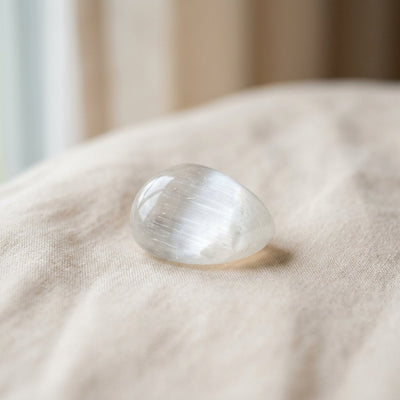
- Cleansing (energetic): Ruby can be cleansed under running water without damage, or set on a piece of Selenite overnight. It does not fade in sunlight, unlike Amethyst.
Ruby jewelry from Sofia's studio
Every Ruby piece is wire-wrapped or strung by hand, cleansed under the full moon, and packed in a hand-stamped pouch.
For everyday: The Ruby Stackable Bracelet at $10.80 is our thinnest stack piece — designed to layer with three or four other bracelets without competing.
For a first Ruby piece: The Ruby Dainty Bracelet at $13.50 has slightly larger beads and reads as a standalone piece.
For summer: The Ruby Anklet at $18.90 sits above bare feet and works with sandals or barefoot.
For collar impact: The Ruby Choker at $20.25 is the pinnacle of red-against-skin. Wonderful with a white linen dress.
For meditation practice: The Ruby & Zoisite 108 Mala at $29.70 is a full mala pairing Ruby with green Zoisite — courage held together with growth.
Pairing Ruby with other stones
Ruby's most beautiful pairings, based on traditional correspondences:
- Ruby + Garnet: A deep-red root-chakra stack. Grounding, protective.
- Ruby + Rose Quartz: Passion and softness. A wedding-anniversary combination.
- Ruby + Carnelian: Fire on fire — for when you need creative energy.
- Ruby + Clear Quartz: The amplifier. Wear Clear Quartz beside Ruby to enhance whatever intention you set.
- Ruby + Hematite: The most grounding of stacks. Wear when you need to feel your feet.
Visit Ruby's stone page for the full profile, or browse our stone library at Crystals to build your own pairing.
Frequently asked questions
Is Ruby a good birthstone gift?
Yes — Ruby is the traditional July birthstone and also the gemstone for the 15th and 40th wedding anniversaries. A Ruby piece works as a birthday gift, an anniversary gift, or a milestone marker.
Are all red gemstones Rubies?
No. Garnet, Spinel, Tourmaline, and Zircon can all appear deep red. True Ruby is corundum with chromium — the family matters more than the color alone. A reputable seller will tell you what you're buying.
How can I tell if a Ruby is real?
Natural Ruby has a hardness of 9, will not scratch under a steel knife, and shows slight color variation under different light sources. Lab-grown Rubies are chemically identical to natural ones — the difference is origin, not authenticity. Glass imitations are softer and often show bubbles under a jeweler's loupe.
Can Ruby be worn every day?
Yes. Ruby is second only to Diamond in hardness and is well-suited to daily wear. The only note is to protect the setting — the stone itself is very durable.
What is Ruby's meaning for love?
Ruby is traditionally associated with the Heart chakra and with passionate, protective love. It is worn to invite courage into relationships and to symbolize enduring devotion — which is why it appears on so many anniversary gifts.
Why is Ruby the July birthstone?
The modern birthstone list was formalized by the American National Retail Jewelers Association (now the American Gem Society) in 1912. Ruby was assigned to July, aligning with much older Polish lapidary traditions from the 15th and 16th centuries.
The Birthstone Series
A complete guide for every month's stone — twelve gems, one for each birthday. Explore the rest of the year:
Jan · Garnet / Feb · Amethyst / Mar · Aquamarine / Apr · Clear Quartz / May · Emerald / Jun · Pearl & Moonstone / Jul · Ruby / Aug · Peridot / Sep · Sapphire / Oct · Opal & Tourmaline / Nov · Topaz & Citrine / Dec · Turquoise & Tanzanite
Every piece is wire-wrapped by hand at Sofia's studio, cleansed under the full moon, and packed in a hand-stamped pouch. If July is your month — or if you're just drawn to the red — we hope this guide helps you find the right piece.
— Sofia