October 14, 2026
Emerald: The Stone With a Garden Inside


Emerald — for successful love
Chakra Heart · Hardness Mohs 7.5 - 8 · Best for love that lasts
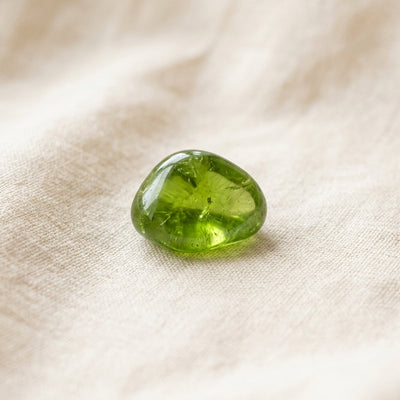
Hold an emerald up to the light and you will not find the cold, glassy clarity a diamond is graded for. You will find something else — a tangle of fine lines, veils and tiny suspended flaws drifting inside the green, as though a whole landscape had been sealed in while the stone was still forming. Jewellers have a name for it, and it is not a word of apology. They call it the jardin: the garden.
The garden inside
Almost every emerald has one. Green beryl grows in such hot, crowded, restless conditions deep in the earth that it traps whatever happens to be nearby — gas, water, the first hints of other crystals — and carries them ever after as inclusions. In most gems an inclusion is a defect, a mark that pulls down the grade and the price. In emerald, the garden is expected and even cherished. A flawless emerald is so rare that gemologists meet it with suspicion; a stone with no garden at all is very often no emerald at all, but glass. Here, the flaws are the proof that the thing is real.
There is something worth sitting with in that. Nearly everywhere else we are taught to hide the garden — to present the clean, unmarked version of ourselves and keep the tangle out of sight. Emerald does the opposite. It carries the whole record of how it was made right out in the open and loses none of its worth for it. If anything, the garden is how you know it has lived.
What emerald has always meant
Emerald has been the heart’s stone for as long as people have worn it. It was mined in Egypt more than three thousand years ago, and Cleopatra loved it so fiercely she claimed the mines as her own. The Romans thought gazing into its green rested tired eyes; across medieval Europe it was set into crowns and rings as a pledge of fidelity. Its colour alone does quiet work — the same forgiving green of a garden after rain, the shade the eye reaches for when it wants to be soothed.
It sits at the heart, and almost every tradition ties it to the same cluster of meanings: loyalty, devotion, a love settled enough to build a home inside. There is an old belief that an emerald would cloud or crack if the one who wore it broke a vow — which makes it a truth-teller as much as a love-token. Where rose quartz opens the heart gently and malachite pushes it toward bold change, emerald is the stone of the love that has already decided to stay.
A care note, because the garden has a cost.
Emerald is hard — 7.5 to 8 on the Mohs scale, harder than quartz — but hardness is not the same as toughness. All those inclusions leave the stone more brittle than its ranking suggests, and most emeralds are treated with a little oil or resin to settle the look of their fractures. A sharp knock can chip one, and an ultrasonic cleaner or a hot soak can strip the oil and leave the garden looking parched. Keep it gentle: lukewarm water, a drop of mild soap, a soft cloth, nothing harsh. Store it on its own so that harder stones cannot scratch it. Treated kindly, it keeps its green for lifetimes.
How to wear it
Emerald rewards a little boldness. It is a saturated, confident colour, and it looks best when you let it be the thing the eye lands on — a single stone at the throat, one set into a ring you will actually wear, a pair small enough for every day but green enough to notice. It warms against the skin, and against almost every complexion it reads as rich rather than loud.
If you want to lean into its heart-opening side, keep it among the stones it already grows beside on a grid: rose quartz for tenderness, green aventurine for luck and steady growth, moonstone for intuition, and peridot for a brighter, sunnier green beside its deep one. Together they make a quietly green corner of a jewellery box — all renewal, all heart.
Who reaches for emerald
Emerald tends to find the person who is done performing perfection — who would rather be loved with the garden showing than admired from a safe distance. It suits the ones building something meant to last: a partnership, a home, a friendship, a life with roots. If you have stopped trying to pass as flawless and started letting people see the whole tangle of you, this is your stone, and it has been waiting a long time to be understood that way.
New to all of this? Begin in the crystal library, or let the quiz point you to the stone that meets you where you are right now.
Next in Gemstone 101: peridot — the green that forms in fire and falls to earth from the sky.
— Sofia