September 23, 2026
Malachite: The Stone That Marks the Turning


Malachite — for powerful transformation
Chakra Heart, Throat · Hardness Mohs 3.5 - 4 · Best for moving through change
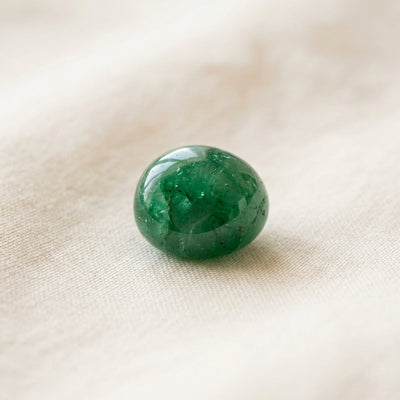
Some stones meet you where you are. Malachite meets you where you are about to be. It is the deep green of a forest floor after rain, banded in rings and eyes like the cross-section of a felled tree, and for as long as people have pulled it from the earth they have handed it across at the hinge points of a life — the leaving, the beginning, the year that split cleanly into a before and an after. If change is already moving through you, whether you asked for it or not, this is the stone the old world would have folded into your palm.
A green that history could not leave alone
Malachite is a copper stone, and its whole story is written in that one fact. It forms slowly, deep in the weathering zones above copper ore, as mineral-rich water seeps through rock and lays down band after band of green — which is why no two pieces ever carry the same rings. Because that green was so vivid and so rare, people have coveted it for at least six thousand years. The ancient Egyptians ground it into one of the world's first cosmetics, a green eyepaint worn as much for protection as for beauty, and named the colour after the stone itself.
Later it became the green of palaces. In the Ural Mountains of Russia, whole seams were quarried to veneer columns, tabletops, and the famous Malachite Room of the Winter Palace, where the stone was sliced thin and matched grain to grain so that a single ripple of green appears to run across an entire wall. For most of its history, then, malachite was the stone of visible transformation — raw ore turned to pigment, to ornament, to the very surfaces of power.
Why it reads as transformation
Look closely at the bands and you are looking at change made solid. Each ring is a season of slow deposition, a record of the stone becoming itself one layer at a time. It is hard to hold that in your hand and not feel the echo: that you, too, are an accretion of every version you have already been. Malachite sits at the heart and the throat — the centre that feels the shift and the centre that has to speak it — which is a fair map of what real change asks of us. First you feel the turn coming. Then, sooner or later, you have to say it out loud.
Sofia keeps a polished piece on the studio windowsill, and she is honest that malachite is not a soft, soothing companion the way rose quartz is. It is the stone of the clear-eyed reckoning — the one you reach for when you already know something has to change and you are done pretending otherwise. It does not make the turning easy. It makes it harder to look away from.
Three small ways to work with it
- Hold it at the start of anything that marks a threshold — a first day, a last conversation, the morning you finally decide.
- Keep it in view through a season of change as a plain reminder that the bands only form by adding one more layer.
- Wear it at the throat when there is a true thing you have been rehearsing and not yet saying.
The science, and one honest caution
Chemically, malachite is copper carbonate hydroxide, and that gleaming green is the copper itself showing through. It is a soft stone — only 3.5 to 4 on the Mohs scale, far softer than the quartz family — so it scratches easily and should be kept away from harder gems that would mark it.
And here is the one stone in this series we ask you to handle with a little more care. Because malachite is a soft copper mineral, its dust is not something to breathe or swallow: never grind, cut, or sand it at home, keep raw and unpolished pieces well away from small children and pets who might mouth them, and skip the water rituals entirely — no soaking, no gem elixirs, no leaving it in the sink. A sealed, polished stone worn as jewelry or held in the palm is perfectly lovely to live with; this is simply about keeping it whole and dry rather than turning it into powder or a drink. Cleanse it the gentle way, with a dry cloth or a pass through incense smoke or a night of moonlight.
Reading the green
- Pale, bright green — fresh starts and the lighter side of change; growth you are glad about.
- Deep forest bands — the classic; steady, grounded transformation with roots.
- The eye — a concentric bullseye of rings, long carried as a mark of protection and watchful care through a passage.
Who it likes to keep company with
Malachite works beautifully with the stones that soften or steady what it stirs up. Pair it with rose quartz when the change is tender and you want to move through it kindly, with green aventurine when you want to turn a transition toward luck and open doors, or with black obsidian when you want protection while you walk through the door you have chosen. You can meet the rest of the family in the crystal library, or, if you are not sure which stone is yours for this particular chapter, let the two-minute quiz point you toward a starting place.
Because that is malachite's whole quiet argument, banded right into the stone: nothing is transformed all at once. The green builds a ring at a time, in the dark, and only later does anyone hold it up to the light and call it beautiful. So does a person. So, most likely, do you.
Next in Gemstone 101: fluorite — the rainbow stone that brings quiet order to a cluttered, overthinking mind.
— Sofia